![[Original size] Capital Stacker (10).png](https://static.wixstatic.com/media/b8f0a7_49ab1c2f900a4bb5b04f885adbc88459~mv2.png/v1/fill/w_120,h_120,al_c,q_85,usm_0.66_1.00_0.01,enc_avif,quality_auto/%5BOriginal%20size%5D%20Capital%20Stacker%20(10).png)

The Broken Housing Ladder Is the Load-Bearing Beam

After I spoke at ULI Trends 2026 earlier this week, a leader from the Metropolitan Indianapolis Board of Realtors pulled me aside and said something that stopped me in my tracks:
“What you described is exactly what we’ve been saying for a while.”
It was affirming and also clarifying. Because when planners, housing strategists, and Realtors are all naming the same problem, it’s no longer a matter of ideology or opinion. It’s a system failure hiding in plain sight.
That’s why a recent article from Realtor.com landed so hard. The headline says it plainly: Six major metros are building more housing — but only for the rich. These are places often held up as “doing it right” because they’re building at scale. And yet, the housing ladder is still broken.
Supply Is Up. The Ladder Is Still Snapped.
The article shows that while housing production has increased in cities like Houston, Dallas, Phoenix, Atlanta, Seattle, and Washington, DC, the type of housing being built is overwhelmingly skewed:
Large, expensive single-family homes on one end
Dense, small-unit rentals on the other
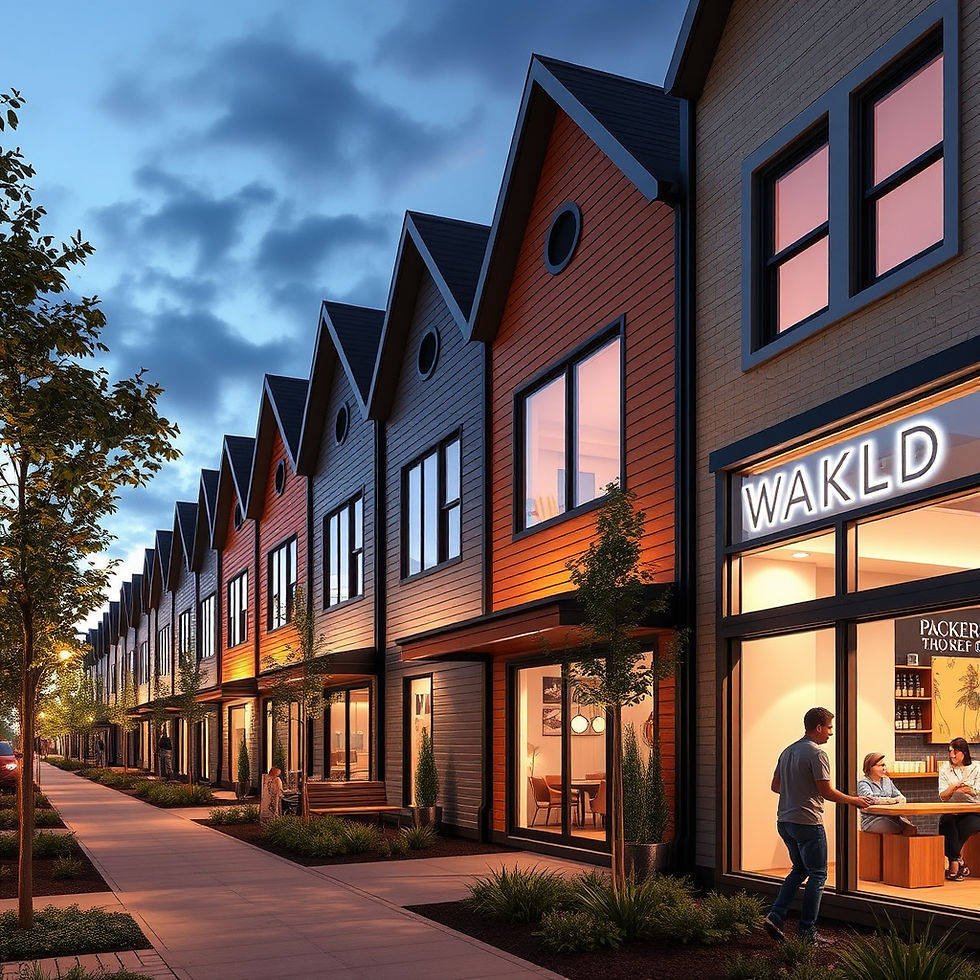
What’s missing - almost entirely - is the middle: starter homes, townhomes, duplexes, small multiplexes, attainable ownership.
That’s not just a market quirk. It’s a structural problem. A ladder made entirely of penthouses and studios isn’t a ladder. It’s two disconnected platforms.
Housing Is the Load-Bearing Beam
What continues to surprise me - even after decades in this work - is how often otherwise forward-thinking, values-driven communities fail to see housing for what it is:
the load-bearing beam of the local economy and civic system.
Housing isn’t downstream of workforce, equity, climate, or economic development. It’s upstream. When the ladder is broken:
Workers can’t stay or advance
Employers can’t recruit or retain
Young families delay or abandon homeownership
Wealth gaps widen - quietly but relentlessly
Communities lose trust in their own plans
And yet, housing is still treated as a technical issue, a zoning debate, or a market outcome rather than core infrastructure.
This Isn’t a “Public Policy vs. Market” Problem
One of the most telling aspects of this moment is who is saying it out loud. Realtors are not anti-growth. They are not anti-density. They see demand every day - buyers who are ready, willing, and qualified enough for the next rung, but who have nowhere to land.
When leaders in the Realtor community say, “Yes, this is exactly it,” they are naming what the data confirms:
We are building housing, but not a functioning housing ladder.
This isn’t about politics. It’s about form. About what our rules, financing systems, and development norms make easy to build - and what they quietly make impossible.
The Work Ahead Is Systems Work
Fixing the housing ladder doesn’t require abandoning affordability goals or market realities. It requires reconnecting the rungs:
aligning zoning, finance, and product
normalizing missing-middle housing
treating attainable ownership as essential infrastructure
activating demand intentionally, not accidentally
Most importantly, it requires communities to stop asking “Are we building housing?”and start asking “Are we rebuilding the ladder?”
Because until we do, no amount of units - no matter how impressive the count - will carry the weight we’re asking housing to bear.
What This Means for Indiana and the Midwest
If this dynamic is showing up in fast-growth metros, it is even more consequential in the Midwest where growth is slower, margins are thinner, and every housing decision carries more weight.
In Indiana and across the Midwest, the broken housing ladder doesn’t show up as dramatic displacement. It shows up as something quieter and more corrosive:
employers who can’t attract mid-career talent
young adults who leave, not because they want to, but because they can’t see a path
small towns and legacy cities with plenty of land, but no attainable product
communities stuck choosing between “luxury or subsidy,” with nothing in between
We don’t have the luxury of letting the market sort this out over decades. When the ladder breaks here, the whole system stalls - workforce, tax base, schools, entrepreneurship, civic leadership.
That’s why the Midwest is actually the testing ground for whether we can rebuild the housing ladder nationally. If we can’t make it work in places with land, infrastructure, and political will, we won’t fix it anywhere.
Why the HOME Method Exists
This is exactly the gap the HOME Method was designed to address. Not as a theory. As a systems response. The core insight is simple:
housing outcomes don’t fail because of a lack of values - they fail because the system is misaligned.
The HOME Method reframes housing as core infrastructure and walks communities through five connected moves:
H — Housing demand is measured, not assumed
O — Ownership pathways are treated as essential, not optional
M — Market-appropriate product is normalized, especially the missing middle
E — Ecosystems are aligned — zoning, finance, builders, employers, buyers
When those pieces move together, the ladder starts working again. Not perfectly. Not overnight. But measurably.
And this is where the Realtor community’s voice matters so much. Realtors sit at the intersection of demand and reality. When they say, “Yes, this is what we’re seeing,” they are validating the need for systems thinking, not just more units.
Final Thought
The most important takeaway from the Realtor.com article isn’t that some cities are building the wrong housing. It’s that good intentions and high production numbers are not enough.
Housing is the load-bearing beam. If the ladder doesn’t work, nothing else holds. The good news? Once you see the beam, you can reinforce it.


Comments